

Our Philosophy
Shaping the future of workplace stress management
High performance and wellbeing should not be competing priorities.
When stress and pressure are understood and managed intelligently, organisations can achieve sustainable performance without burning out their people.
The Principles Behind Our Approach
These principles underpin everything we do.
Stress should be recognised before it becomes burnout
Burnout doesn't happen overnight. It's the result of a build-up of unmanaged stress.
We believe it is much easier for individuals and organisations to address the early warning signs before they develop into more complex problems.
Stress needs a clear definition
Just as organisations define clear behavioural expectations as the basis for managing performance, we believe they also need a clear definition of what healthy and unhealthy workplace stress looks like, as the basis for recognising, measuring, discussing and managing it effectively.
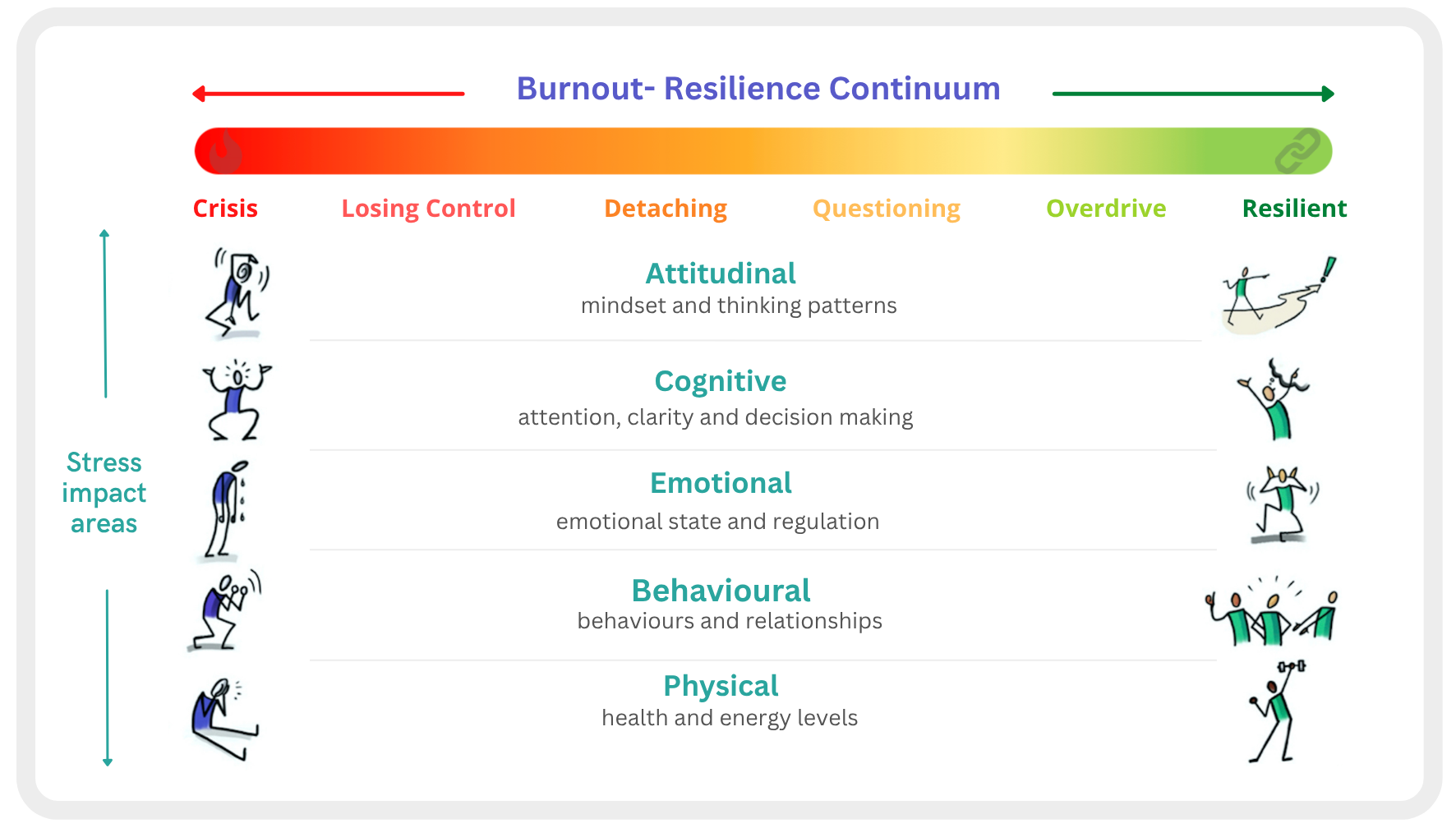
The AURA Burnout–Resilience Continuum provides that definition.
How we define stress
The AURA Burnout–Resilience Continuum provides a shared standard and common language for recognising, discussing and measuring stress consistently across individuals, teams and organisations. It maps observable attitudinal, cognitive, emotional, behavioural and physical indicators across the continuum from resilience to burnout crisis.
Stress should be measured as rigorously as other organisational risks
Organisations routinely measure performance, engagement, customer satisfaction, financial performance and safety because these indicators inform better decisions and drive organisational improvement.
Yet stress, despite influencing all of these outcomes, is rarely measured with the same consistency or rigour.
We believe employee stress should become a routine organisational measure that helps leaders understand emerging risks, monitor progress and make better decisions.
Confidentiality enables honest disclosure
Stress is sensitive and not readily disclosed therefore employees must be persuaded that their responses are kept confidential and that they will receive helpful insights to inform a personal action plan.
We believe that this approach encourages honest disclosure of their stress and that the anonymised group reporting provides a safe way of channelling issues into action.
Managing stress requires action at both the individual and workplace level
Stress may be experienced personally, but its causes often lie in organisational systems, leadership, workplace culture or unsustainable ways of working.
Helping individuals recognise, disclose and manage their own stress is essential. Equally important is understanding and addressing the workplace factors that contribute to stress.
When collections of employees report similar experiences of stress, it signals that the issue is unlikely to be individual alone. Instead, it provides valuable insight into how work is designed, led and experienced, highlighting where focused organisational action is needed.
We believe lasting change comes from addressing stress at both the individual and workplace level — supporting people to build resilience while continually improving the systems in which they work.
Start with the problem, not the intervention
Different individuals, teams and business areas experience different pressures and challenges. There is rarely one intervention that will work everywhere.
We believe organisations should first understand what needs attention and where, rather than defaulting to generic wellbeing initiatives or predetermined solutions.
Insight helps identify the problem — but it doesn't prescribe the answer. Those closest to the work should be involved in exploring the causes and shaping the interventions that are most likely to make a difference..
Stress data should be discussed openly
Data alone doesn't create change. It should facilitate open dialogue, build shared understanding and support constructive conversations between employees, teams and leaders.
Leadership involvement and commitment is essential for success
Collecting employee feedback creates an obligation to act.
Employees are far more likely to engage openly when they see leaders genuinely committed to understanding workplace stress and addressing its root causes.
Visible leadership commitment builds trust, turns insight into action and ensures stress management becomes more than a tick-box exercise.
Insight should lead to action
Collecting data is only the beginning.
Stress management should be an ongoing cycle of measurement, discussion, action and review.
We believe organisations need practical ways of interpreting findings, agreeing priorities and implementing focused actions that improve both employee wellbeing and organisational performance.
Stress management should be embedded into organisational life
We believe organisations should embed stress awareness, measurement, conversations and action into everyday leadership and organisational practice
Our Ambition
To help make workplace stress management a normal part of organisational life.
Our ambition is to help organisations embed the tools and systems needed to recognise, measure, discuss and manage workplace stress as routinely as they manage performance, health and safety or financial risk.
Let’s build healthier, more resilient organisations
If you would like to explore how AURA could support your organisation, get in touch.